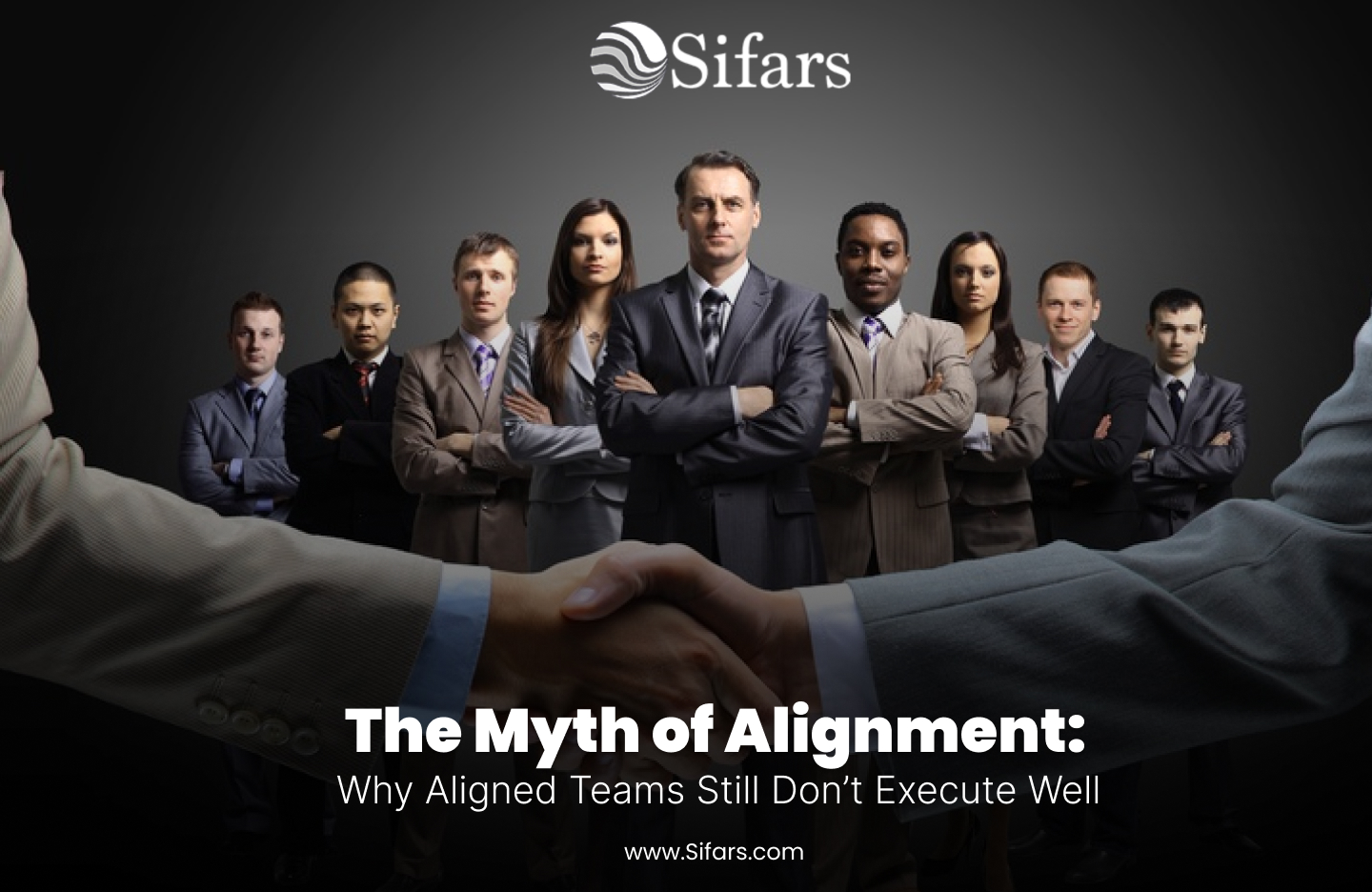
“Everyone is aligned.”
It is one of the most reassuring phrases leaders like to hear. The strategy is clearly defined, roadmaps are shared across teams, and meetings often end with agreement and consensus.
Yet despite this alignment, organizations frequently struggle with execution.
Projects move slowly. Decisions stall. Outcomes fall short of expectations.
If everyone is aligned, why does performance still suffer?
The reality is that alignment alone does not guarantee execution. In many organizations, alignment becomes a comforting illusion that hides deeper structural problems.
Many companies begin addressing this challenge by redesigning workflows and systems with the help of a custom software development company that can build platforms supporting better decision-making and operational efficiency.
What Organizations Mean by Alignment
When companies claim that teams are aligned, they usually mean:
- Everyone understands the strategy
- Goals are documented and communicated
- Teams agree on priorities
- KPIs are shared across departments
On paper, this appears to be progress.
However, agreement about goals rarely changes how work actually happens inside the organization.
People may agree on what matters but still struggle to move work forward effectively.
Agreement Is Not the Same as Execution
Alignment operates at the level of ideas and understanding.
Execution operates at the level of operations and systems.
Leaders can align teams around a strategy in a single meeting, but execution depends on hundreds of daily decisions made under pressure, uncertainty, and competing priorities.
Execution usually breaks down when:
- Decision rights are unclear
- Ownership is spread across multiple teams
- Dependencies between teams are hidden
- Local incentives conflict with global outcomes
These structural problems cannot be solved through presentations or alignment meetings.
Organizations increasingly rely on enterprise software development services to build operational systems that support faster decision-making and workflow clarity.
Why Aligned Teams Still Stall
1. Alignment Without Decision Authority
Teams may agree on priorities but lack the authority to act.
When:
- every decision requires escalation
- approvals accumulate for safety
- decisions are revisited repeatedly
execution slows down dramatically.
Alignment without decision authority creates polite paralysis.
2. Conflicting Incentives Beneath Shared Goals
Teams may share the same high-level objective but operate under different incentives.
For example:
- one team is rewarded for speed
- another for risk reduction
- another for efficiency or utilization
While everyone agrees on the overall goal, the incentives encourage behaviors that conflict with each other.
This leads to friction, delays, and repeated work.
3. Hidden Dependencies Slow Execution
Alignment meetings often overlook real operational dependencies.
Execution depends on factors such as:
- who needs what information
- when inputs must arrive
- how teams hand off work
If these dependencies are not clearly defined, aligned teams spend time waiting for one another instead of moving forward.
Many organizations improve operational coordination through platforms developed by a software consulting company that integrates workflows across departments.
4. Alignment Does Not Redesign Work
In many cases, organizations change their goals but keep their work structures unchanged.
The same systems remain in place:
- approval chains
- reporting structures
- meeting schedules
- fragmented tools
Teams are expected to produce better results using the same systems that previously slowed them down.
Alignment becomes an expectation layered on top of structural inefficiencies.
The Real Problem: Systems, Not Intent
Execution failures are often blamed on:
- company culture
- poor communication
- lack of commitment
However, the real issue is frequently system design.
Systems determine:
- how quickly decisions move
- where accountability resides
- how information flows
- what behaviors are rewarded
No amount of alignment can fix systems that slow down work.
Organizations addressing these challenges often implement platforms built through enterprise software development services that align workflows with business outcomes.
Why Leaders Overestimate Alignment
Alignment feels measurable and visible.
Leaders can easily track:
- presentations shared
- communication updates
- documented objectives
Execution, on the other hand, is complex and messy.
It involves:
- trade-offs
- judgment calls
- accountability tensions
- operational constraints
As a result, organizations often invest heavily in alignment activities while neglecting the design of execution systems.
What High-Performing Organizations Do Differently
High-performing companies do not abandon alignment, but they stop treating it as the ultimate goal.
Instead, they focus on execution clarity.
They:
- define decision ownership explicitly
- organize workflows around outcomes rather than departments
- reduce unnecessary handoffs
- align incentives with end-to-end performance
In these organizations, execution becomes a system capability rather than an individual effort.
Many companies build such systems with the help of a software development outsourcing company that designs integrated operational platforms.
From Alignment to Flow
Effective execution creates flow.
Work moves smoothly when:
- decisions are made close to the work
- information arrives at the right moment
- accountability is clearly defined
- teams have the freedom to exercise judgment
Flow does not emerge from alignment meetings.
It emerges from well-designed systems.
The Cost of Chasing Alignment Alone
When organizations mistake alignment for execution:
- meetings increase
- governance layers expand
- additional tools are introduced
- leaders apply more pressure
However, pressure cannot compensate for poor system design.
Eventually:
- high performers burn out
- progress slows
- confidence declines
Leaders then wonder why aligned teams still fail to deliver.
Final Thought
Alignment is not the problem.
Overconfidence in alignment is.
Execution rarely fails because people disagree. It fails because systems are not designed for action.
The organizations that succeed ask a different question.
Instead of asking:
“Are we aligned?”
They ask:
“Is our system capable of producing the outcomes we expect?”
That is where real performance begins.
At Sifars, we help organizations redesign systems, workflows, and decision structures so alignment translates into real execution.
Connect with Sifars to build systems that convert alignment into action.