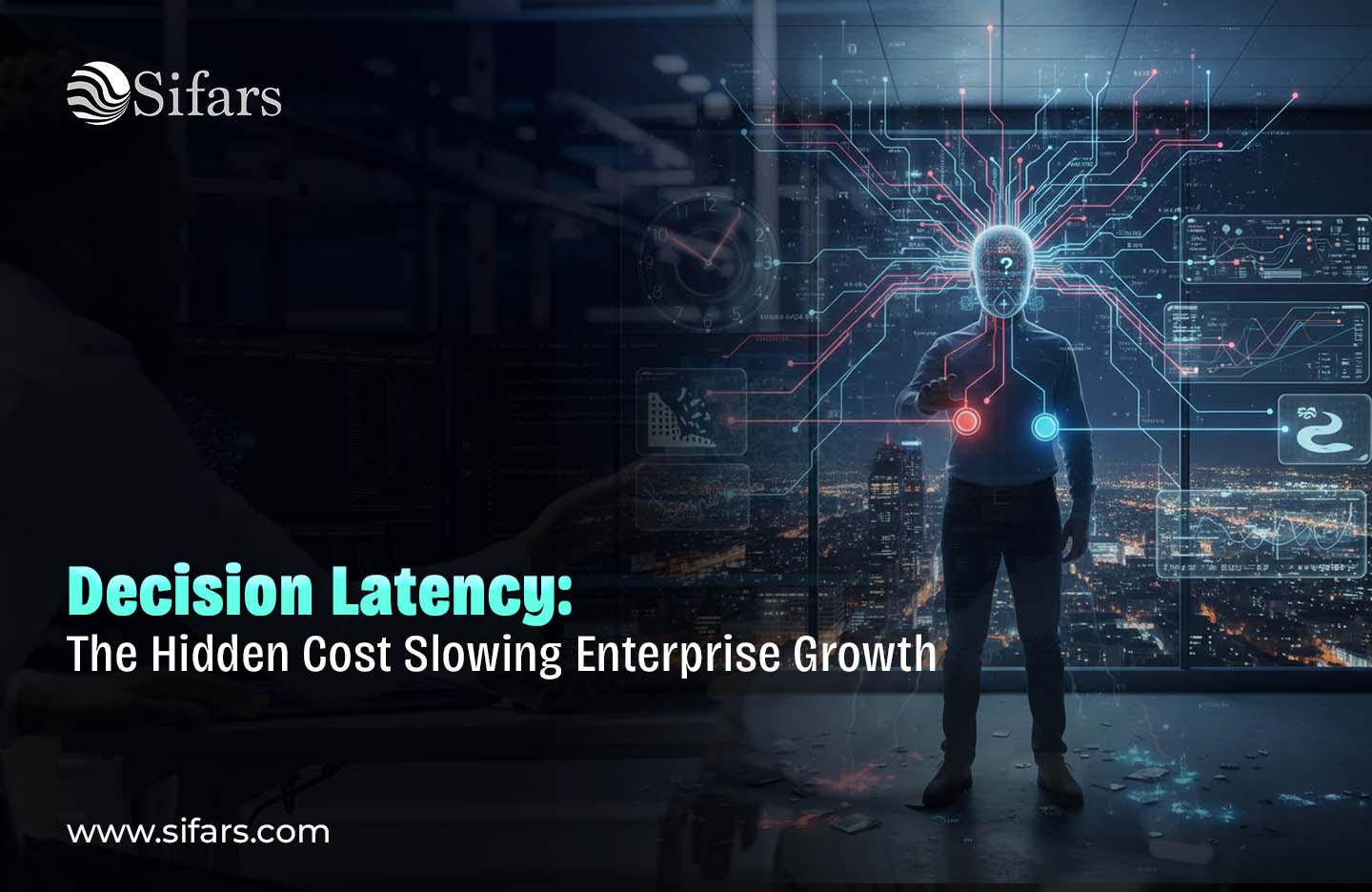
Most businesses believe their biggest barriers to growth are market conditions, competitive pressure, or talent shortages. Yet within many large organizations there is a quieter and far more expensive problem: decisions simply take too long.
Strategic approvals move slowly, investments remain stuck in review cycles, and promising opportunities lose relevance before action is taken. This hidden delay is known as decision latency, and it often goes unnoticed.
Decision speed rarely appears on financial statements, but its impact is significant. Slow decisions reduce execution speed, weaken accountability, and gradually erode competitive advantage.
Over time, decision latency becomes one of the largest obstacles to sustainable enterprise growth.
Organizations working with modern enterprise software development services often discover that growth depends not only on technology or strategy, but on how quickly decisions can move through the organization.
What Decision Latency Really Means
Decision latency is not simply about long approval times or too many meetings.
It represents the total time lost between recognizing that a decision must be made and actually taking effective action.
In large enterprises, the issue rarely comes from individuals. It comes from organizational structure.
As companies grow, decision-making becomes layered across management levels, committees, and governance frameworks. These structures are designed to reduce risk, but they frequently introduce friction that slows momentum.
The result is an organization that hesitates when it should move quickly.
How Decision Latency Develops
Decision latency rarely appears suddenly.
It grows gradually as organizations expand, add controls, and formalize processes.
Several factors commonly contribute to this problem:
- unclear ownership of decisions across departments
- multiple approval layers without defined limits
- overreliance on consensus instead of accountability
- fear of failure in regulated or politically sensitive environments
Each of these elements may appear reasonable on its own. Combined, they create a system where slow decision-making becomes the default behavior.
The Growth Cost of Slow Decisions
When decision-making slows down, the impact on growth becomes visible in subtle but powerful ways.
Market opportunities shrink because competitors move faster. Internal initiatives stall while teams wait for direction. Innovation slows because experiments require extensive approvals.
More importantly, slow decisions signal uncertainty.
Teams begin waiting for validation instead of acting. Ownership weakens, and execution becomes inconsistent.
Over time the organization develops a culture of hesitation.
Growth depends not only on having strong strategies but on the ability to act on those strategies quickly.
When More Data Slows Decisions
Many organizations respond to uncertainty by demanding more data.
In theory, data-driven decision-making should improve outcomes. In practice, it often introduces additional delays.
Reports are refined repeatedly, forecasts are verified again and again, and teams continue searching for perfect certainty.
This leads to analysis paralysis.
Decisions should be informed by data, not delayed by it.
This pattern is closely related to the challenges described in When Data Is Abundant but Insight Is Scarce, where organizations struggle to convert information into timely decisions.
Culture Plays a Major Role
Decision speed is heavily influenced by organizational culture.
When employees fear mistakes, decisions move upward for validation. Teams avoid ownership and wait for senior approval.
This creates a reinforcing cycle.
Because fewer decisions are made at operational levels, leadership becomes overloaded with approvals. Governance grows heavier and the organization slows even further.
High-performing organizations intentionally design cultures that reward clarity, accountability, and action.
The Impact on Teams and Talent
Decision latency does not only affect business performance it also affects people.
High-performing teams thrive on momentum. When projects stall due to delayed approvals, motivation declines and frustration increases.
Employees become disengaged when their work repeatedly pauses while waiting for decisions.
Eventually the most capable employees leave not because the work is difficult, but because progress feels impossible.
This dynamic resembles the challenges discussed in Measuring People Is Easy. Designing Work Is Hard, where structural issues in work design reduce productivity despite strong individual performance.
Reducing Decision Latency Without Increasing Risk
Organizations often assume that faster decisions require sacrificing control.
In reality, successful companies combine speed with governance through clear decision frameworks.
Reducing decision latency typically requires:
- defining ownership for decisions at the correct organizational level
- establishing clear escalation paths and approval limits
- empowering teams within defined decision boundaries
- regularly identifying and removing decision bottlenecks
When decision rights are clearly defined, speed increases without sacrificing accountability or compliance.
Decision Velocity as a Competitive Advantage
Organizations that grow rapidly treat decision velocity as a core capability.
They recognize that not every decision must be perfect—many simply need to be timely.
Faster decisions enable organizations to adapt quickly, test new ideas, and capture opportunities that slower competitors miss.
Over time, improved decision velocity compounds into a significant strategic advantage.
Companies building digital operating models often rely on custom software development services to create systems that connect insights directly to decision workflows.
Final Thought
Decision latency is one of the most overlooked barriers to enterprise growth.
It rarely produces dramatic failures, yet its cumulative impact spreads throughout the organization.
For companies seeking sustainable growth, improving strategy alone is not enough. They must also examine how decisions move through the organization, who owns them, and how quickly they can be executed.
Growth ultimately belongs to organizations that can decide—and act—faster than their competitors.
If your organization struggles to turn plans into action due to approvals and uncertainty, decision latency may be the underlying cause.
Sifars helps enterprise leaders identify decision bottlenecks and design governance models that enable speed while maintaining control.
👉 Connect with us to explore how faster decision-making can unlock sustainable growth.