Nearly all AI strategies begin the same way.
They focus on data.
They evaluate tools.
They compare models, vendors, and infrastructure.
Roadmaps are created for platforms and capabilities. Technical maturity justifies the investment, and success is defined in terms of deployment and adoption.
Yet despite all this effort, many AI initiatives fail to deliver sustained business impact.
What’s missing is not technology.
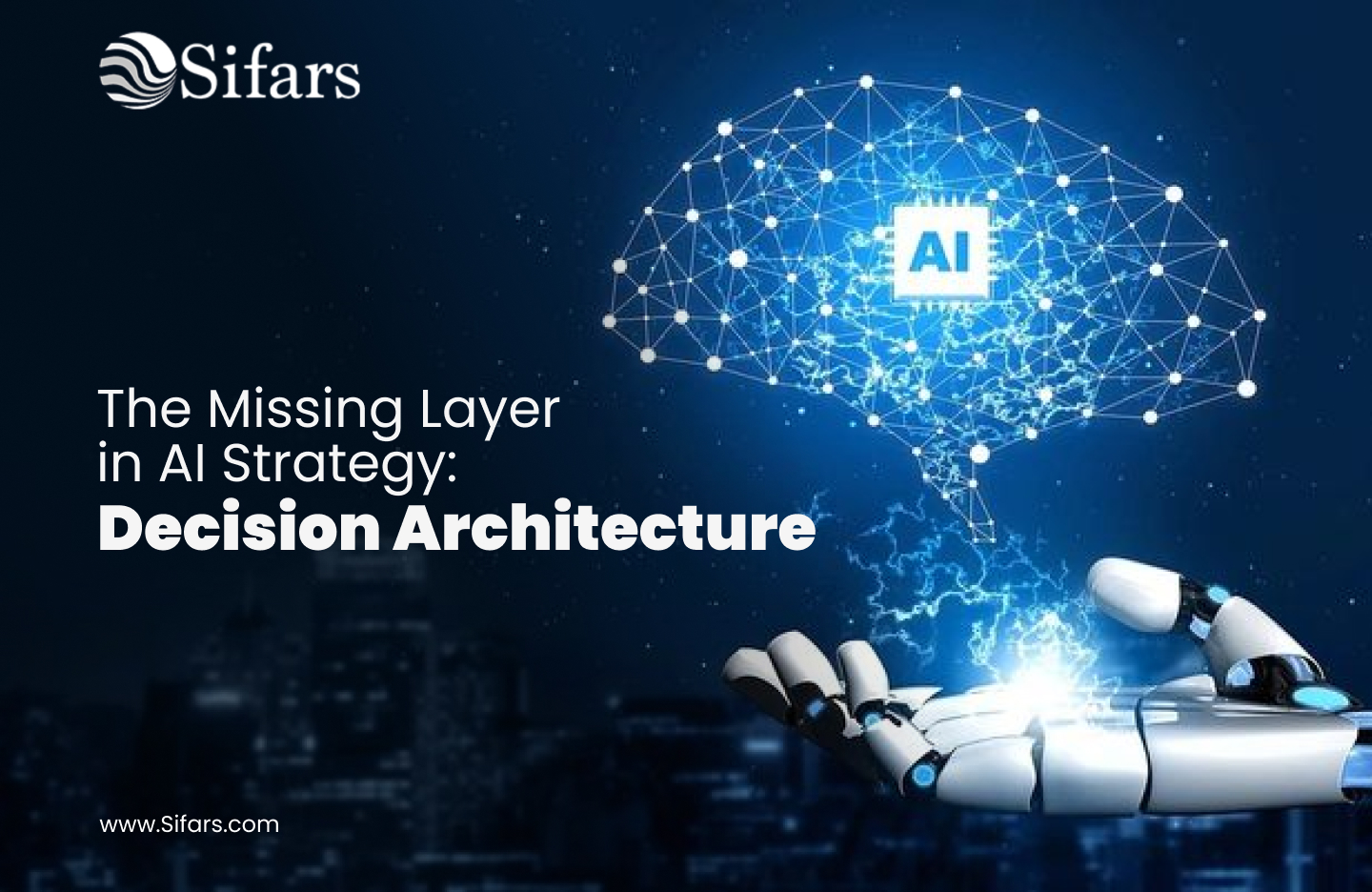
It’s decision architecture.
Many organizations partner with an AI development company expecting technology alone to transform operations. But without a system that connects AI insights to real decisions, even the most advanced models remain underutilized.
AI Strategies Optimize Intelligence, Not Decisions
Artificial intelligence excels at producing intelligence:
- Predictions
- Recommendations
- Pattern recognition
- Scenario analysis
But intelligence alone does not create value.
Value only appears when a decision changes because of that intelligence.
Yet many AI strategies fail to answer the most important questions:
- Which decisions should AI improve?
- Who owns those decisions?
- How much authority does AI have?
- What happens when AI conflicts with human judgment?
Without clear answers, AI becomes informative rather than transformative.
Organizations investing in AI automation services are increasingly recognizing that automation must be paired with structured decision ownership.
What Is Decision Architecture
Decision architecture is the structured framework for how decisions are made inside an organization.
It defines:
- Which decisions matter most
- Who is responsible for them
- What information is used
- What constraints apply
- How trade-offs are resolved
- When decisions are escalated
In simple terms, decision architecture turns insight into action.
Without it, outputs from AI models drift through organizations without a clear destination.
Why AI Exposes Weak Decision Systems
AI systems are extremely precise.
They expose:
- Inconsistent goals
- Unclear ownership
- Conflicting incentives
When AI recommendations are ignored or endlessly debated, the problem is rarely the model.
The real issue is that organizations never agreed on how decisions should be made.
This idea connects closely to
AI Didn’t Create Complexity — It Revealed It, where AI exposes hidden inefficiencies within organizational systems.
The Cost of Ignoring Decision Architecture
Without decision architecture, predictable patterns appear:
- AI insights sit on dashboards waiting for approval
- Teams escalate decisions to avoid responsibility
- Executives override models “just to be safe”
- Automation is deployed without authority
- Learning loops break down
The result is AI that informs — but does not influence.
Companies working with an enterprise AI development company often focus on designing decision frameworks before expanding automation initiatives.
Decisions Must Come Before Data
Many AI strategies start with the wrong questions:
- What data do we have?
- What predictions can we build?
- What can we automate?
High-performing organizations reverse this sequence.
They ask:
- Which decisions create the most value?
- Where are decisions slow or inconsistent?
- What outcomes matter most?
- How should trade-offs be handled?
Only after answering these questions do they design the necessary data, models, and workflows.
This shift transforms AI from an analytics layer into a decision system.
AI That Strengthens Human Judgment
When AI operates inside a strong decision architecture:
- Ownership is clear
- Authority is defined
- Escalation is minimized
- Incentives support action
AI recommendations trigger decisions instead of debates.
This relationship between AI insight and decision ownership is also explored in
From Recommendation to Responsibility: The Missing Step in AI Adoption.
In such environments, AI does not replace human judgment.
It strengthens it.
Decision Architecture Enables Responsible AI
Clear decision structures also address one of the biggest concerns surrounding AI: risk.
When organizations define:
- When human intervention is required
- When automation is allowed
- What guardrails apply
- Who is accountable
AI becomes safer rather than riskier.
Ambiguity creates risk.
Structure reduces it.
Organizations often work with an AI consulting company to design these frameworks alongside AI implementation.
From AI Strategy to AI Execution
An AI strategy without decision architecture is simply a technology strategy.
A complete AI strategy answers:
- Which decisions will change?
- How quickly will they change?
- Who trusts the AI output?
- How will success be measured through outcomes?
Until these questions are addressed, AI will remain a layer on top of existing work rather than the engine driving it.
This challenge is also connected to
More AI, Fewer Decisions: The New Enterprise Paradox, where organizations generate insights but struggle to act on them.
Final Thought
The next wave of AI advantage will not come from better models.
It will come from better decision design.
Companies that build strong decision architecture will move faster, act more consistently, and unlock real value from AI.
Those that don’t will continue generating more intelligence — while wondering why nothing changes.
At Sifars, we help organizations design decision architectures that enable AI systems to drive real execution instead of remaining analytical tools.
If your AI strategy feels technically strong but operationally weak, the missing layer may not be data or tools.
It may be how decisions are designed.
👉 Reach us at https://www.sifars.com to build AI strategies that deliver real outcomes.