Category: Supply Chain Management

  • The End of Linear Roadmaps in a Non-Linear World

    The End of Linear Roadmaps in a Non-Linear World

    Reading Time: 3 minutes

    Linear roadmaps were the foundation of organizational planning for decades. Clearly define a vision, split it into multiple parts, give them dates and implement one by one. It succeeded when markets changed slowly, competition was predictable and change occurred at a rather linear pace.

    That world no longer exists.

    Volatile, interconnected and non-linear is today’s environment in which we are operating. Technology shifts overnight. Customer needs change more quickly than quarterly planning can accommodate. Regulatory headwinds, market shocks and platform dependencies collide in unpredictable ways. But many organizations still use linear roadmaps — unwavering sequences based on assumptions that reality no longer honors.

    The result isn’t just a series of deadlines missed. It is strategic fragility.

    How Linear Roadmaps Ever Worked To understand why we are where we are, it’s important to go back in time.

    Linear roadmaps were created in a period of equilibrium. You would know what input to pump in, dependencies were manageable and outcomes were fairly controllable. That was possible because the organizational environment rewarded consistent execution more than adaptability.

    In that way, linearity meant clarity:

    • Teams knew what came next
    • Progress was easy to measure
    • Accountability was straightforward
    • Coordination costs were low

    But these advantages rested on one crucial assumption: One could reasonably expect that the future would look a lot like the past, smooth enough that it was possible to plan for.

    That assumption has quietly collapsed.

    The World is Non-Linear And that’s the reality!

    The systems of today are not linear. Little tweaks can have outsized effects. The independent variables have complex interaction between them. Feedback loops shorten the timespan between cause and effect.

    In a non-linear world:

    • Tiny product change can mean the difference between fire and growth
    • One failure of dependency and so many initiatives can be stalled
    • An AI model refresh might be able to change the pattern of decision making across the company
    • Competitive advantages vanish much more quickly than they can be planned for

    Linear roadmaps fail here, since they rely on a simple causality and stability of the sequence. In fact, everyone is always changing.

    Why Linear Planning Doesn’t Work in The Real World

    Linear roadmaps do not fail noisily. They fail quietly.

    Teams keep doing work until they deem their initial assumptions wrong. Dependencies multiply without visibility. Decisions are delayed because it feels scarier to change the roadmap than to stick with it. Most of the effort is carried out before leadership even realizes that the plan has become irrelevant.

    Common symptoms include:

    • Constant re-prioritization preserving the initial structure
    • Cosmetic reworked roadmaps without hard-rebooted above done and only that.
    • Teams focused on delivery, not relevance
    • Success as measured by compliance not outcomes

    The roadmap becomes a relic of solace — not a directional instrument.

    The Price of Memory Over Learning

    One of the most serious hazards of linear roadmaps is early commitment.

    When plans are locked in place ahead of time, organizations optimize for execution over learning. New information serves as a disturbance, not an insight. Defending plans is rewarded while challenging them penalized.

    This is paradoxical: As the environment becomes more uncertain, the planning process becomes more rigid.

    Eventually organizations cease to re‐adapt in “real time.” They adjust only at predetermined intervals, and by the time you know there’s truly a need to tweak, in many cases it’ll be too late.

    From Roadmaps to Navigation Systems

    High-performing organizations aren’t ditching planning — they’re reimagining it.

    They don’t work with static roadmaps but dynamic navigation tools. The systems are intended to adapt and take feedback, change course as needed.

    Key characteristics include:

    Decision-Centric Planning

    Plans are made around decisions, not deliverables. Teams focus on what decisions need to be made, with what information and by whom.

    Outcome-Driven Direction

    Success is defined by results and learning velocity, not completion of tasks. Achievement is measured in relevance, not on paper.

    Short Planning Horizons

    Long-term commitment is evident, albeit action plans are of short duration and flexible. This lowers the cost of change while maintaining strategic continuity.

    Built-In Feedback Loops

    Data, signals from customers and operational insights are all pumped directly into planning cycles for the fastest possible course correction.

    Leadership in a Non-Linear Context

    Leadership also has to evolve.

    In a non-linear world, leaders cannot be held accountable for accurately predicting the future. They are meant to build systems that respond intelligently to it.

    This means:

    • Autonomous teams within borders of authority
    • Encouraging experimentation without chaos
    • Rewarding learning, not just delivery
    • Releasing certainty and embracing responsefulness

    We move from inflexible plans to sound decision frameworks.

    Technology as friend — or foe

    Technology can paradoxically hasten adaptability or entrench rigidity.

    Fixed processes They are created by tools that strictly enforce a process with hard-coded dependencies, inflexible approvals and instead of enabling, the forces an organization to perform the same linear behavior over and over. When properly designed, these afford for quick sensing, distributed decision making and adjustable actions.

    However, the distinction is not really in the tools, but how purposefully we bring them into our decision making.

    The New Planning Advantage

    In a non-linear world competitive advantage is not from having the best plan.

    It comes from:

    • Detecting change earlier
    • Responding faster
    • Making better decisions under uncertainty
    • Learning continuously while moving forward

    Linear roadmaps promise certainty. Adaptive systems deliver resilience.

    Final Thought

    The future doesn’t happen in straight lines. It never really was — we just pretended it was for long enough that linear planning made sense.

    Businesses who still insist on their rigid roadmaps will only fall further behind the curve. Those who adopt adaptive, decision-centric planning will not only survive volatility; they’ll turn it to their advantage.

    The end of linear roadmaps is not undisciplined.

    It is the first line of strategic intelligence.

    Connect with Sifars today to schedule a consultation 

    www.sifars.com

  • When Data Is Abundant but Insight Is Scarce

    When Data Is Abundant but Insight Is Scarce

    Reading Time: 4 minutes

    Today, the world’s institutions create and use more data than ever before. Dashboards update live, analytics software logs every exchange and reports compile themselves across sectors. One would think that such visibility would make organizations faster, keener and surer in decision-making.

    In reality, the opposite is frequently so.

    Instead of informed, leaders feel overwhelmed. Decisions aren’t made faster; they’re made more slowly. And teams argue about metrics while faltering in execution. Just when we have more information available to us than ever, clear thinking seems harder than ever to achieve.

    The problem is not lack of data. It is insight scarcity.

    The Illusion of Being “Data-Driven”

    Most companies think they are data-driven by nature of collecting and looking at huge amounts of data. Surrounded by charts and KPIs, performance dashboards, it seems like you’re in control, everything is polished.

    But seeing data is not the same as understanding it.

    The vast majority of analytics environments are built to count stuff not drive a decision. The metrics multiply as teams adopt new tools, track new goals and react to new leadership requests. In the long run, organizations grow data-rich but insight-poor. They know pieces of what is happening, but find it difficult to make sense of what is truly important, or they feel uncertain about how to act.

    As each function optimizes for its own KPIs, leadership is left trying to reconcile mixed signals rather than a cohesive direction.

    Why More Data Can Lead to Poorer Decisions

    Data is meant to reduce uncertainty. Instead, it often increases hesitation.

    The more data that a company collects, the more labor it has to spend in processing and checking up upon it. Leaders hesitate to commit and wait for more reports, more analysis or better forecasts. A quest for precision becomes procrastination.

    It’s something that causes a paralyzing thing to happen. It isn’t that decisions are delayed because we lack the necessary information, but because there’s too much information bombarding us all at once. Teams are careful, looking for certainty that mostly never comes in complex environments.

    You learn over time that the organization is just going to wait you out instead of act on your feedback.

    Measures Only Explain What Happened — Not What Should Be Done

    Data is inherently descriptive. It informs us about what has occurred in the past or is occurring at present. Insight, however, is interpretive. It tells us why something occurred and what it means going forward.

    Most dashboards stop at description. They surface trends, but do not link them to trade-offs, risks or next steps. Leaders are given data without context and told to draw their own conclusions.

    That helps explain why decisions are frequently guided more by intuition, experience or anecdote — and data is often used to justify choices after they have already been made. Analytics lend the appearance of rigor, no matter how shallow the insight.

    Fragmented Ownership Creates Fragmented Insight

    Data ownership is well defined in most companies; insight ownership generally isn’t.

    Analytics groups generate reports but do not have decision rights. Business teams are consuming data but may lack the analytical knowledge to act on it appropriately. Management audits measures with little or no visibility to operational constraints.

    This fragmentation creates gaps. Insights fall between teams. We all assume someone else will put two and two together. “I like you,” is the result: Awareness without accountability.

    Insight is only powerful if there’s someone who owns the obligation to turn information into action.

    When Dashboards Stand in for Thought

    I love dashboards, but they can be a crutch, as well.

    When nothing changes, regular reviews give the feeling that things are under control. Numbers are monitored, meetings conducted and reports circulated — but results never change.

    In these settings, data is something to look at rather than something with which one interacts. The organization watches itself because that’s what it does, but it almost never intervenes in any meaningful way.

    Visibility replaces judgment.

    The Unseen Toll of Seeing Less

    The fallout from a failure of insight seldom leaves its mark as just an isolated blind spot. Instead, it accumulates quietly.

    Opportunities are recognized too late. It’s interesting that those risks are recognized only after they have become facts. Teams redouble their efforts, substituting effort for impact. Strategic efforts sputter when things become unstable.

    Over time, organizations become reactive. They react, rather than shape events. They are trapped because of having state-of-the-art analytics infrastructure, they cannot move forward with the confidence that nothing is going to break.

    The price is not only slower action; it is a loss of confidence in decision-making itself.

    Insight Is a Design Problem, Not a Skill Gap.

    Organizations tend to think that better understanding comes from hiring better analysts or adopting more sophisticated tools. In fact, the majority of insight failures are structural.

    Insight crumbles when data comes too late to make decisions, when metrics are divorced from the people responsible and when systems reward analysis over action. No genius can make up for work flows that compartmentalize data away from action.

    Insight comes when companies are built screen-first around decisions rather than reports.

    How Insight-Driven Organizations Operate

    But organizations that are really good at turning data into action act differently.

    They restrict metrics to what actually informs decisions. They are clear on who owns which decision and what the information is needed for. They bring implications up there with the numbers and prioritize speed over perfection.

    Above all, they take data as a way of knowing rather than an alternative to judgment. Decisions get made on data, but they are being made by people.

    In such environments, it is not something you review now and then but rather is hardwired into how work happens.

    From data availability to decision velocity

    The true measure of insight is not how much data an organization has at its disposal, but how quickly it improves decisions.

    The velocity of decision is accelerated when insights are relevant, contextual and timely. This requires discipline: resisting the temptation to quantify everything, embracing uncertainty and designing systems that facilitate action.

    When organizations take this turn, they stop asking for more data and start asking better questions.

    How Sifars Supports in Bridging the Insight Gap

    At Sifars, we partner with organisations that have connected their data well but are held back on execution.

    We assist leaders in pinpointing where insights break down, redesigning decision flows and synchronizing analytics with actual operational needs. We don’t want to build more dashboards, we want to clarify what decisions that matter and how data should support them.

    By tying insight directly to ownership and action, we help companies operationalize data at scale in real-time, driving actions that move faster — with confidence.

    Conclusion

    Data ubiquity is now a commodity. Insight is.

    Organizations do not go ‘under’ for the right information. They fail because insight is something that requires intentional design, clear ownership and the courage to act when perfect certainty isn’t possible.

    As long as data is first created as a support system for decisions, adding more analytics will only compound confusion.

    If you have a wealth of data but are starved for clarity in your organization, the problem isn’t one of visibility. It is insight — and its design.

  • Why Cloud-Native Doesn’t Automatically Mean Cost-Efficient

    Why Cloud-Native Doesn’t Automatically Mean Cost-Efficient

    Reading Time: 3 minutes

    Cloud-native code have become the byword of modern tech. Microservices, container, and serverless architectures along with on-demand infrastructure are frequently sold as the fastest path for both scaling your startup to millions of users and reducing costs. The cloud seems like an empty improvement over yesterday’s systems for a lot of organizations.

    But in reality, cloud-native doesn’t necessarily mean less expensive.

    In practice, many organizations actually have higher, less predictable costs following their transition to cloud-native architectures. The problem isn’t with the cloud per se, but with how cloud-native systems are designed, governed and operated.

    The Myth of Cost in Cloud-Native Adoption

    Cloud platforms guarantee pay-as-you-go pricing, elastic scaling and minimal infrastructure overhead. Those are real benefits, however, they depend on disciplined usage and strong architectural decisions.

    Jumping to cloud-native without re-evaluating how systems are constructed and managed causes costs to grow quietly through:

    • Always-on resources designed to scale down
    • Over-provisioned services “just in case”
    • Duplication across microservices
    • Inability to track usage trends.

    Cloud-native eliminates hardware limitations — but adds financial complexity.

    Microservices Increase Operational Spend

    Microservices are meant to be nimble and deployed without dependency. However, each service introduces:

    • Separate compute and storage usage
    • Monitoring and logging overhead
    • Network traffic costs
    • Deployment and testing pipelines

    When there are ill-defined service boundaries, organizations pay for fragmentation instead of scalability. Teams go up more quickly — but the platform becomes expensive to run and maintain.

    More is not better architecture. They frequently translate to higher baseline costs.

    Nothing to Prevent Wasted Elastic Scaling

    Cloud native systems are easy to scale, but scaling-boundlessly being not efficient.

    Common cost drivers include:

    • Auto-scaling thresholds set too conservatively
    • Quickly-scalable resources that are hard to scale down
    • Serverless functions more often than notMeasureSpec triggered.
    • Continuous (i.e. not as needed) batch jobs

    “Without the aspects of designing for cost, elasticity is just a tap that’s on with no management,” explained Turner.

    Tooling Sprawl Adds Hidden Costs

    Tooling is critical within a cloud-native ecosystem—CI/CD, observability platforms, security scanners, API gateways and so on.

    Each tool adds:

    • Licensing or usage fees
    • Integration and maintenance effort
    • Data ingestion costs
    • Operational complexity

    Over time, they’re spending more money just on tool maintenance than driving to better outcomes. At the infrastructure level, cloud-native environments may appear efficient but actually leak cost down through layers of tooling.

    Lack of Ownership Drives Overspending

    For many enterprises, cloud costs land in a gray area of shared responsibility.

    Engineers are optimized for performance and delivering. Finance teams see aggregate bills. Operations teams manage reliability. But there is no single party that can claim end-to-end cost efficiency.

    This leads to:

    • Unused resources left running
    • Duplicate services solving similar problems
    • Little accountability for optimization decisions

    Benefits reviews taking place after the event and fraud-analysis happening when they occur only

    Dev-Team change model Cloud-native environments need explicit ownership models — otherwise costs float around.

    Cost Visibility Arrives Too Late

    By contrast cloud platforms generate volumes of usage data, available for querying and analysis once the spend is incurred.

    Typical challenges include:

    • Delayed cost reporting
    • Problem of relating costs to business value
    • Poor grasp of which services add value
    • Reactive Teams reacting to invoices rather than actively controlling spend.

    Cost efficiency isn’t about cheaper infrastructure — it’s about timely decision making.

    Cloud-Native Efficiency Requires Operational Maturity

    CloudYes Cloud Cost Efficiency There are several characteristics that all organizations, who believe they have done a good job at achieving cost effectiveness in the cloud, possess.

    • Clear service ownership and accountability
    • Architectural simplicity over unchecked decomposition
    • Guardrails on scaling and consumption
    • Ongoing cost tracking linked to the making of choices
    • Frequent checks on what we should have, and should not

    Cloud native is more about operational discipline than technology choice.

    Why Literary Now Is A Design Problem

    Costs in the cloud are based on how systems are effectively designed to work — not how current the technologies used are.

    Cloud-native platforms exacerbate this if workflows are inefficient, dependencies are opaque or they do not take decisions fast enough. They make inefficiencies scalable.

    Cost effectiveness appears when systems are developed based on:

    • Intentional service boundaries
    • Predictable usage patterns
    • Quantified trade-offs between flexibility and cost
    • Speed without waste governance model

    How Sifars Assists Businesses in Creating Cost-Sensitive Cloud Platforms

    At Sifars, we assist businesses in transcending cloud adoption to see the true potential of a mature cloud.

    We work with teams to:

    • Locate unseen cloud-native architecture cost drivers
    • Streamline service development Cut through the confusion and develop services simply and efficiently.
    • Match cloud consumption to business results
    • Create governance mechanisms balancing the trade-offs between speed, control and cost

    It’s not our intention to stifle innovation — we just want to guarantee cloud-native systems can scale.

    Conclusion

    Cloud-native can be a powerful thing — it just isn’t automatically cost-effective.

    Unmanaged, cloud-native platforms can be more expensive than the systems they replace. The cloud is not just cost effective. This is the result of disciplining operating models and smart choices.

    Those organizations that grasp this premise early on gain enduring advantage — scaling more quickly whilst retaining power over the purse strings.

    If your cloud-native expenses keep ticking up despite your modern architecture, it’s time to look further than the tech and focus on what lies underneath.

  • Building Trust in AI Systems Without Slowing Innovation

    Building Trust in AI Systems Without Slowing Innovation

    Reading Time: 3 minutes

    Artificial intelligence is advancing so rapidly that it will soon be beyond the reach of most organizations to harness for crucial competitive gains. This trend shows no signs of slowing; models are getting better faster, deployment cycles reduced, and competitive pressure is driving teams to ship AI-enabled features before you can even spell ML.

    Still, one hurdle remains to impede adoption more than any technological barrier: trust.

    Leaders crave innovation but they also want predictability, accountability and control. Without trust, AI initiatives grind to a halt — not because the technology doesn’t work, but because organizations feel insecure depending on it.

    The real challenge is not trust versus speed.

    It’s figuring out how to design for both.

    Why trust is the bottleneck to AI adoption

    AI systems do not fail in a vacuum. They work within actual institutions, affecting decisions, processes and outcomes.

    Trust erodes when:

    • AI outputs can’t be explained
    • Data sources are nebulous or conflicting
    • Ownership of decisions is ambiguous
    • Failures are hard to diagnose
    • Lack of accountability when things go wrong

    When this happens, teams hedge. Instead of acting on insights from A.I., these insights are reviewed. There, humans will override the systems “just in case.” Innovation grinds to a crawl — not because of regulation or ethics but uncertainty.

    The Trade-off Myth: Control vs. Speed

    For a lot of organizations, trust means heavy controls:

    • Extra approvals
    • Manual reviews
    • Slower deployment cycles
    • Extensive sign-offs

    They are often well-meaning, but tend to generate negative rather than positive noise and false confidence.

    The very trust that we need doesn’t come from slowing AI.

    It would be designing systems that produce behavior that is predictable, explainable and safe even when moving at warp speed.

    Trust Cracks When the Box Is Dark 

    For example, someone without a computer science degree might have a hard time explaining how A.I. is labeling your pixels.

    Great teams are not afraid of AI because it is smart.

    They distrust it, because it’s opaque.

    Common failure points include:

    • Models based on inconclusive or old data
    • Outputs with no context or logic.
    • Nothing around confidence levels or edge-cases No vis of conf-levels edgecases etc.
    • Inability to explain why a decision was made

    When teams don’t understand why AI is behaving the way it is, they can’t trust the AI to perform under pressure.

    Transparency earns far more trust than perfectionism.

    Trust Is a Corporate Issue, Not Only a Technical One

    Better models are not the only solution to AI trust.

    It also depends on:

    • Who owns AI-driven decisions
    • How exceptions are handled
    • “I want to know, when you get it wrong.”
    • It’s humans, not tech These folks have their numbers wrong How humans and AI share responsibility

    Without clear decision-makers, AI is nothing more than advisory — or ignored.

    Trust grows when people know:

    • When to rely on AI
    • When to override it
    • Who is accountable for outcomes

    Building AI Systems People Can Trust

    What characterizes companies who successfully scale AI is that they care about operational trust in addition to model accuracy.

    They design systems that:

    1. Embed AI Into Workflows

    AI insights show up where decisions are being made — not in some other dashboard.

    1. Make Context Visible

    The outputs are sources of information, confidence levels and also implications — it is not just recommendations.

    1. Define Ownership Clearly

    Each decision assisted by AI has a human owner who is fully accountable and responsible.

    1. Plan for Failure

    Systems are expected to fail gracefully, handle exceptions, and bubble problems to the surface.

    1. Improve Continuously

    Feedback loops fine-tune the model based on actual real-world use, not static assumptions.

    Trust is reinforced when AI remains consistent — even under subpar conditions.

    Why Trust Enables Faster Innovation

    Counterintuitively, AI systems that are trusted move faster.

    When trust exists:

    • Decisions happen without repeated validation
    • Teams act on assumptions rather than arguing over them
    • Experimentation becomes safer
    • Innovation costs drop

    Speed is not gained by bypassing protections.”

    It’s achieved by removing uncertainty.

    Governance without bureaucracy revisited 

    Good AI governance is not about tight control.

    It’s about clarity.

    Strong governance:

    • Defines decision rights
    • Sets boundaries for AI autonomy
    • Ensures accountability without micromanagement
    • Evolution as systems learn and scale

    Because when governance is clear, not only does innovation not slow down; it speeds up.

    Final Thought

    AI doesn’t build trust in its impressiveness.

    It buys trust by being trustworthy.

    The companies that triumph with AI will be those that create systems where people and A.I. can work together confidently at speed —not necessarily the ones with the most sophisticated models.

    Trust is not the opposite of innovation.

    It’s the underpinning of innovation that can be scaled.

    If your AI efforts seem to hold promise but just can’t seem to win real adoption, what you may have is not a technology problem but rather a trust problem.

    Sifars helps organisations build AI systems that are transparent, accountable and ready for real-world decision making – without slowing down innovation.

    👉 Reach out to build AI your team can trust.

  • The Cost of Invisible Work in Digital Operations

    The Cost of Invisible Work in Digital Operations

    Reading Time: 3 minutes

    Digital work is easily measured by what we see: the dashboards, delivery timelines, automation metrics and system uptime. On paper, everything looks efficient. Yet within many organizations, a great deal of work occurs quietly, continuously and unsung.

    This is all invisible work — and it’s one of the major hidden costs of modern digital operations.

    Invisible work doesn’t factor into KPIs, but it eats time, dampens velocity, and silently caps scale.

    What Is Invisible Work?

    “It’s the work that is necessary to keep things going, that no one sees because systems are either invisible to us or lack of clarity about what we own in a system,” she said.

    It includes activities like:

    • Following up for missing information
    • Clarifying ownership or approvals
    • Reconciling mismatched data across systems
    • Rechecking automated outputs
    • Translating insights into actions manually
    • Collaborate across teams to eliminate ambiguities

    None of that work generates business value.

    But without it, work would grind to a halt.

    Why Invisible Work Is Growing in Our Digital Economy

    In fact, with businesses going digital, invisible work is on the rise.

    Common causes include:

    1. Fragmented Systems

    Data is scattered across tools that don’t talk to each other. Teams waste time trying to stitch context instead of executing.

    1. Automation Without Process Clarity

    “You can automate tasks but not uncertainty. Humans intervene to manage exceptions, edge cases and failures — often manually.

    1. Unclear Decision Ownership

    When no one is clearly responsible for a decision, work comes to a halt as teams wait for validation, sign-offs or alignment.

    1. Over-Coordination

    More tools and teams yields more handoffs, meetings, and status updates to “stay aligned.”

    Digital tools make tasks faster — but bad system design raises the cost of coordination.

    The Hidden Business Cost

    Invisible work seldom rings alarms, yet it strikes with a sting.

    Slower Execution

    Work moves, but progress doesn’t. Projects languish among teams rather than within them.

    Reduced Capacity

    Top-performing #teams take time maintaining flow versus producing results.

    Increased Burnout

    People tire from constant context-switching and follow-ups, even if workloads seem manageable.

    False Signals of Productivity

    The activity level goes up — the meetings and messages, updates — but momentum goes down.

    The place appears busy, but feels sluggish.

    Why the Metrics Don’t Reflect the Problem

    Many operational metrics concentrate on the outputs.

    • Tasks completed
    • SLAs met
    • Automation coverage
    • System uptime

    It is in this space between measures that invisible work resides.

    You won’t find metrics for:

    • Time spent chasing clarity
    • Energy lost in coordination
    • Decisions delayed by ambiguity

    By the point that such performances decline, the harm has already been done.

    Invisible Work and Scale: The 2x+ Value Chain

    As organizations grow:

    • Other teams interact with the same workflows
    • Yet we continue to introduce more approvals “in order to be safe”
    • More tools enter the stack

    Each addition creates small frictions. Individually, they seem harmless. Collectively, they slow everything down.

    Growth balloons invisible work unless systems are purposefully redesigned.

    What High-Performing Organizations Do Differently

    Institutions that do away with invisible work think not in terms of individual elbow grease but of system design.

    They:

    • And make ownership clear at every decision milestone.
    • Plan your workflow based on results, not work.
    • Reduce handoffs before adding automation
    • Integrate data into decision-making moments
    • Measure flow, not just activity

    Clear systems naturally eliminate invisible work.

    Technology Doesn’t Kill Middle-Class Jobs, Public Policy Does

    Further) we keep adding tools, without fixing the structure, that often just add more invisible work.

    True efficiency comes from:

    • Clear decision rights
    • Nice bit of context provided at the right moment
    • Fewer approvals, not faster ones
    • Action-guiding systems, not merely status-reporting ones

    Digital maturity isn’t that you have to do everything, it’s that less has to be compensatory.

    Final Thought

    Invisible work is a toll on digital processes.

    It does take time, it takes resources and talent — never to be reflected on a scorecard.

    It’s not that people aren’t working hard, causing organizations to experience a loss in productivity.

    They fail because human glue holds systems together.

    The true opportunity is not to optimize effort.

    It is to design work in which hidden labor is no longer required.

    If your teams appear to be constantly busy yet execution feels slow, invisible work could be sapping your operations.

    Sifars enables enterprises to identify latent friction in digital workflows and re-assess the systems by which effort translates into impetus.

    👉 Reach out to us if you want learn more about where invisible work is holding your business back – and how to free it.

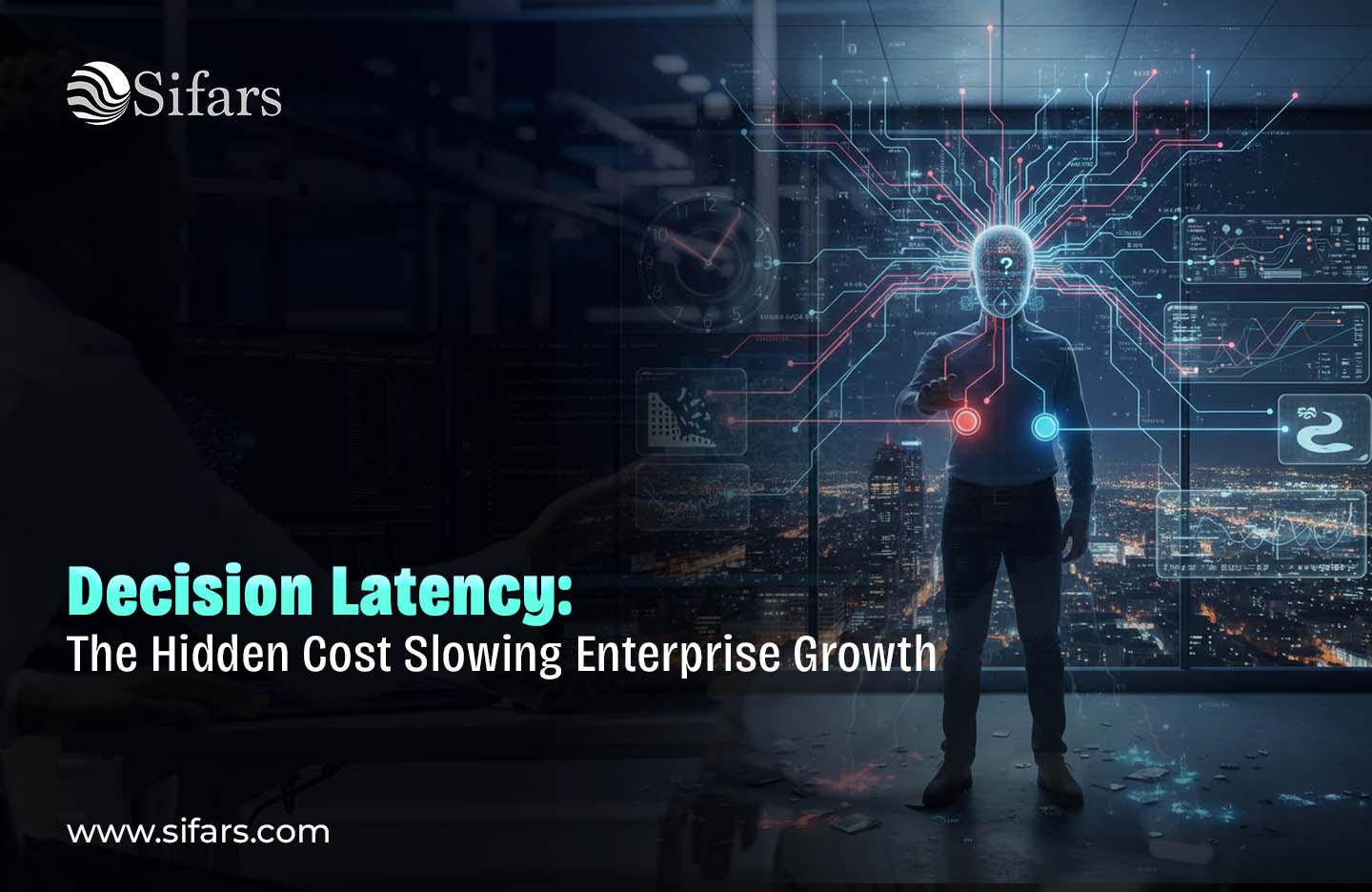
  • Decision Latency: The Hidden Cost Slowing Enterprise Growth

    Decision Latency: The Hidden Cost Slowing Enterprise Growth

    Reading Time: 4 minutes

    Most businesses think their biggest barriers to growth are market conditions, competition or shortages of talent. But deep inside many big, established companies there is a quieter, less obvious and much more expensive problem: decisions are too slow. Approvals on strategy are slow, investments queue up and even the promising ones turn obsolete before decisions are taken. This little delay is called decision latency, and you have missed it.

    Decision speed doesn’t show up on a P&L but it is measurable. It reduces speed of execution, undermines accountability and kills competitive advantage. It eventually emerges the single greatest impediment to sustainable business expansion.

    What Decision Latency Really Means

    It is not just about long times to approval, or an excess of meetings. It is the sum of lost time between realization of the fact that a decision needs to be made and actual effective action. In big Companies it’s less about individuals and more about organisation.

    Decision making is layered as organizations grow. Power is diffused through structures, committees or governance teams. And while these structures are built to control risk, they frequently add friction that can hinder momentum. The result is a membership that plods when it should, once in a while at least, damn the torpedoes and go full speed ahead.

    How Decision Latency Creeps In

    Decision latency rarely arrives suddenly. He is a growing thing, as companies add controls, build out teams and formalize workflows. And then, as the years pass, certainty gives way to doubt.

    Common contributors include:

    • Ambiguity of responsibility for decisions by function
    • Various approval levels with no set limits
    • Overdependence on consensus in place of accountability
    • Fear of failure in regulated environments and the political space

    Individually, each piece can make a certain kind of sense! Together, they form a system such that velocity is the outlier, not the standard.

    The Price of Indecision For Growth

    When decisions bog down, growth begins to wilt in less visible ways. The market possibilities are shrinking as the competition gets there faster. Things get stagnant inside as teams wait for a decision. Experimentation is hard to get approved, and innovation grinds to a halt.

    More significantly, slow decisions have the effect of indicating uncertainty. Teams become gun-shy, ownership gets watered down and execution suffers. With time the organisation begins to have a culture of waiting to see who leads and follows.

    Growth hinges not only on good strategy, but the capacity to act decisively.

    Why Making Decisions Gets Harder With More Data

    “There is uncertainty, so let’s demand more data,” is an all-too-common response to business uncertainty within enterprises. There is such a thing as too much data-driven decision, it can turn into a replacement for accountability.

    In a lot of organisations, we wait on taking decisions until certainty arrives – but it never does. Reports are polished, forecasts verified, always more quotes are written down. This leads to analysis paralysis, in which decisions are delayed despite sufficient information.

    Decisions should be informed by data, not dragged down by it.

    Decision Latency and Organisational Culture

    Speed of decision-making is also heavily influenced by culture. Decisions get bumped up when people are afraid to take risks.” Leaders want validation, not ownership and teams don’t make calls that might draw scrutiny.

    This engenders a cycle over time. With fewer decisions being made at the execution level, leadership is flooded with approvals. Precaution becomes complacency.

    VUCA-busting firms consciously architect cultures that incent clarity, accountability and swift action.

    Impact on Teams and Talent

    Decision lateness affects more than numbers and growth — it also affects people. High-performing teams thrive on momentum. When decisions are slow in coming, motivation falls off and frustration increases.

    They are reluctant when their work is paralysed “by indecision. ives fail, public support and confidence is eroded.” Eventually, work becomes hard not as it is difficult to do, but the effort is in vain. Enable organisations are at risk of losing their best and most enabled employees.

    Using the perfect memory model to reduce latency of decision without adding risk

    Speed and stability/spin control tend to work against each other. In practice, successful organizations do both by creating explicit decision frameworks.

    Reducing decision latency requires:

    • Businesses have decision making clearly owned at the correct level
    • Clear escalation paths and approval limits
    • Team empowerment within the scope parties have agreed to.
    • Regular review of decision-making bottlenecks

    With defined decision rights speed is increased — while governance is not sacrificed.

    Decision Velocity as an Advantage

    Organizations that scale at a rapid pace treat decision velocity as the central skill they must succeed at. They know not every decision requires perfection — many require speed. And these organisations respond to change more quickly and seize opportunities that others miss, by getting decision making faster.

    Decision velocity compounds over time. Tiny increments of increased velocity throughout the organization add up to a huge competitive advantage.

    How Sifars Enables Enterprises to Overcome Decision Latency

    At Sifars we engage with the enterprises to pin-point where decision latency is rooted in their operating model. Our attention is on creating transparency over ownership, simplifying governance and bringing decision making in line with ambitious strategy.

    We help companies design systems where insights are turned into decisions, and those decisions become tested actions quickly—all without adding operational or regulatory risk.

    Conclusion

    One of the most overlooked obstacles for organizational growth is decision delay. It is not something that makes loud noises but it has a very silent effect throughout the organisation.

    For companies that want to scale in a sustainable manner, it should go beyond strategy and execution to how decisions are made, who owns them & how fast you can move.

    Growth is the province of those organisations that choose—and do —for assertive reasons.

    If your organization has a hard time grounding plans into activity, or slows down by ways of approvals and concerns it may be time to root decision latency out at the root.

    Sifars works with enterprise leaders to uncover decision bottlenecks and design governance models that allow speed with control.

    👉 Reach out to us and let’s discuss how making faster decisions can unblock sustainable growth.

    www.sifars.com

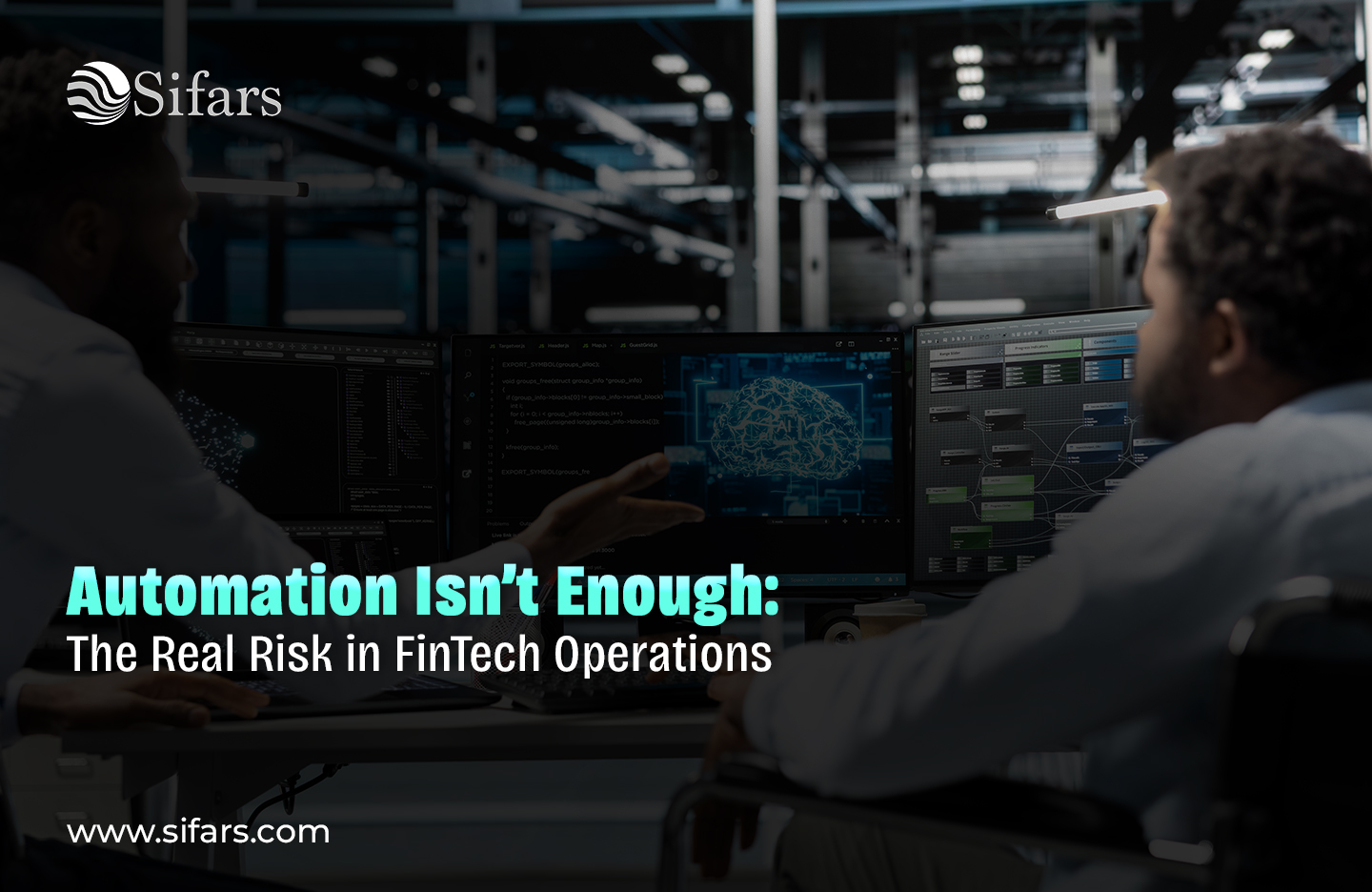
  • Automation Isn’t Enough: The Real Risk in FinTech Operations

    Automation Isn’t Enough: The Real Risk in FinTech Operations

    Reading Time: 4 minutes

    Within the FinTech industry today, automation is key. From instant transfer of payments and real-time prevention of fraud to automated onboarding or compliance checks, the use of technology has allowed financial services to move faster, spread more widely and run with greater efficiency those at any time in history. In many companies, automation is exciting stuff — as it should be.

    But as financial technology firms increasingly depend on computers to make their decisions, another type of threat presents itself — silently and more dangerously. Automation by itself does not ensure operational resiliency. Indeed, a heavy reliance on automation without the attendant organisational checks and balances can create vulnerabilities that are orders of magnitude more difficult and costly to uncover.

    At Sifars, we commonly observe that the actual risk in FinTech operations is not non-automation, but inadequate operational maturity around automation

    The Automation Advantage—and Its Limits

    It’s not hard to see why automation is so valuable for FinTech. It alleviates manual work, shortens turnaround times and ensures repeatable execution on scale. Processes that used to take days now occur in seconds. Customer demands have changed accordingly, adding significant strain on FinTech companies to deliver fast and easy.

    Yet automation thrives in predictable environments. Financial operations are rarely predictable. They are influenced by changes in regulations, fraud trends, system interdependencies and human judgement. If automation is applied without taking this complexity into consideration, it ends up concealing the weakness rather than solving it.

    But then efficiency is fragile.

    Operational Risk Doesn’t Go Away — It Morphs

    One of the great myths is that in FinTech, everybody believes automation removes risk. In truth, it just moves where risk resides. Human errors might decrease, but systemic risk rises when activities get closely bound up and secretive.

    Automated systems can fail silently. A single misconfiguration, discrepancy in data, or third-party outage can surge through operations before anyone observes it. Once the problem has become known, customer impact, regulatory liability and reputational harm can already be substantial.

    In automated settings, risk is more opaque and more potent.

    The Technology illusion of control

    Automation can lead to a false impression of control. Dashboards are green, workflows run as expected, and alerts are fired when they exceed the threshold. This has the potential to hypnotise organisations into thinking that they can run without a hitch.

    In fact, most FinTech companies don’t have enough insight into how their machine processes perform under stress. Exception handling is weak, escalation channels are ambiguous and manual triggers are infrequently exercised. When systems misbehave, teams run around like headless chickens – not because they are any less talented or skilled but more that no one in the organisation ever thought to plan for what happens when their failure modes actually occur.

    Real control can be had only through preparedness, not merely as a result of automation.

    More Than Speed Needed on Regulatory Complexity

    The environment in which FinTechs are doing business is one of the most regulated. Automation is a great way to manage enforcement at scale, but it should not be a substitute for judgment, accountability or governance. Regulatory requirements are constantly changing and an automated rule will soon be out of date if not scrutinized.

    Without investment in operational governance, organisations may build compliance processes which are technically effective but strategically vulnerable. Regulators are not measuring for sophistication in automation – they’re measuring outcomes and a company’s accountability and controls.

    Speed without control is dangerous in regulated environments.

    People and Processes Still Matter

    As we continue to automate much of this, a number of organizations underinvest in people and process design. Responsibilities blur, ownership becomes fuzzy and teams no longer have end-to-end visibility into how things operate. When there are problems, nobody knows who is responsible or where to step in and fix things.

    Top performing FinTech firms understand that automation should serve as an enabler of human potential, not a robot in disguise.“ Effective ownership, documented processes and trained teams are still important. Without them, automation is brittle and hard to maintain.

    Operational resilience relies on all the people who understand how that system works — not just systems that operate independently. 

    Third-Party Dependencies Multiply Risk

    External vendors, APis, cloud platforms and data providers play a significant role in modern FinTech ecosystems. The dependence on these systems has been incorporated more tightly into production processes through automation, making exposure to external failures higher.

    Automated workflows often collapse in an unpredictable manner as soon as third-party systems fall over or misbehave. For organisations without contingency planning and visibility into these dependencies, it’s a case of respond rather than react.

    Automation increases scale — but it also increases dependence.

    The Real Danger: Maximizing Efficiency Only For some reason, it never occurred to us that having this muscle cramp meant my muscles couldn’t work as well!

    The risk in FinTech is not a technical one- it’s strategic. A lot of organizations over optimize for efficiency and under optimize for resilience. Automation becomes the end rather than the means.

    This results in systems that do very well under ideal conditions, but buckle when things get tough. The real source of operational strength is our ability to adapt, recover and learn — not just to execute.”

    Building Resilient FinTech Operations

    Automation is only one element of the overall operational approach. Resilient FinTech organisations focus on:

    • Robust operational governance:  And Strong ownership of process:
    • Continuous monitoring beyond surface-level metrics
    • Regular tests of edge cases and failure modes
    • Human-in-the-loop in an automated pipeline
    • Alignment of various Technology, Compliance and Business teams

    Those who make these things work together will see automation as an enabler, not a multiplier of risk.

    How Sifars Assists FinTechs In Going Beyond Automation

    We are working with FinTech companies to build a sustainable operational models & technology backbone at Sifars. We identify the invisible risks, we improve process transparency and we create a governance framework that keep pace with automation.

    We enable businesses to transition from automation-centric efficiency to operational resilience and control – so that growth does not mean sacrificing stability.

    Conclusion

    Automation is certainly key to the success of FinTech—but it is also insufficient. Without rigorous operational design, governance and human oversight, automated systems can introduce risks that are “far easier to see than to manage.”

    Future of FinTech goes to those that combine speed with resilience and innovation with control.

    If your FinTech operations are entirely dependent upon automation without an understanding of risk, governance and resilience, then maybe it is time to assess what’s happening underneath the water.

    Sifars Sifars supports the world’s best FinTech companies to surface operational blind spots and to build systems that work securely and resiliently at scale.

    👉 Get in touch to discover how your operations can scale securely—as well as quickly.

    www.sifars.com

  • Why Leadership Dashboards Don’t Drive Better Decisions

    Why Leadership Dashboards Don’t Drive Better Decisions

    Reading Time: 3 minutes

    There are leadership dashboards all over the place. Executives use dashboards to keep an eye on performance, risks, growth measures, and operational health in places like boardrooms and quarterly reviews. These tools claim to make things clear, keep everyone on the same page, and help you make decisions based on evidence.

    Even if there are a lot of dashboards, many businesses still have trouble with sluggish decisions, priorities that don’t match, and executives that react instead of planning.

    The problem isn’t that there isn’t enough data. The thing is that dashboards don’t really affect how decisions are made.

    Seeing something doesn’t mean you understand it.

    Dashboards are great for illustrating what happened. Trends in revenue, usage rates, customer attrition, and headcount growth are all clearly shown. But just being able to see something doesn’t mean you understand it.

    Leaders don’t usually make decisions based on just one metric. They have to do with timing, ownership, trade-offs, and effects. Dashboards show numbers, but they don’t necessarily explain how they are related or what would happen if you act—or don’t act—on those signals.

    Because of this, leaders look at the data but still use their gut, experience, or stories they’ve heard to decide what to do next.

    Too much information and not enough direction

    Many modern dashboards have too many metrics. Each function wants its KPIs shown, which leads to displays full of charts, filters, and trend lines.

    Dashboards don’t always make decisions easier; they can make things worse. Instead of dealing with the real problem, leaders spend time arguing about which metric is most important. Instead of making decisions, meetings become places where people talk about data.

    When everything seems significant, nothing seems urgent.

    Dashboards Aren’t Connected to Real Workflows

    One of the worst things about leadership dashboards is that they don’t fit into the way work is done.

    Every week or month, we look over the dashboards.

    Every day, people make choices.

    Execution happens all the time.

    By the time insights get to the top, teams on the ground have already made tactical decisions. The dashboard is no longer a way to steer; it’s a way to look back.

    Dashboards give executives information, but they don’t change the results until they are built into planning, approval, and execution systems.

    At the executive level, context is lost.

    By themselves, numbers don’t always tell the whole story. A decline in production could be due to process bottlenecks, unclear ownership, or deadlines that are too tight. A sudden rise in income could hide rising operational risk or employee weariness.

    Dashboards take away subtleties in order to make things easier. This makes data easier to read, but it also takes away the context that leaders need to make smart choices.

    This gap often leads to efforts that only tackle the symptoms and not the core causes.

    Not just metrics, but also accountability are needed for decisions.

    Dashboards tell you “what is happening,” but they don’t often tell you “who owns this?”

    What choice needs to be made?

    What will happen if we wait?

    Without defined lines of responsibility, insights move between teams. Everyone knows there is a problem, yet no one does anything about it. Leaders think that teams will respond, and teams think that leaders will put things first.

    The end outcome is decision paralysis that looks like alignment.

    What Really Makes Leadership Decisions Better

    Systems that are built around decision flow, not data display, help people make better choices.

    Systems that work for leaders:

    Get insights to the surface when a decision needs to be made.

    Give background information, effects, and suggested actions

    Make it clear who is responsible and how to go up the chain of command.

    Make sure that strategy is directly linked to execution.

    Dashboards change from static reports to dynamic decision-making aids in these kinds of settings.

    From Reporting to Making Decisions

    Organizations that do well are moving away from dashboards as the main source of leadership intelligence. Instead, they focus on enabling decisions by putting insights into budgeting, hiring, product planning, and risk management processes.

    Data doesn’t simply help leaders here. It helps people take action, shows them the repercussions of their choices, and speeds up the process of getting everyone on the same page.

    Conclusion

    Leadership dashboards don’t fail because they don’t have enough data or are too complicated.

    They fail because dashboards don’t make decisions.

    Dashboards will only be able to generate improved outcomes if insights are built into how work is planned, approved, and done.

    More charts aren’t the answer to the future of leadership intelligence.

    Leaders can make decisions faster, act intelligently, and carry out their plans with confidence because of systems.

    Connect with Sifars today to schedule a consultation 

    www.sifars.com

  • Why Talent Analytics Fails Without Workflow Integration

    Why Talent Analytics Fails Without Workflow Integration

    Reading Time: 3 minutes

    Talent analytics is now a key part of modern HR strategy. Companies spend a lot of money on tools that promise to show them how well they are hiring, how likely they are to lose employees, how productive their workers are, how engaged they are, and what skills they will need in the future. The evidence seems strong on paper.

    But in real life, a lot of businesses have trouble using talent analytics to make better decisions or get demonstrable results.

    The problem isn’t the quality of the data, the complexity of the models, or the lack of effort from HR departments. The true reason talent analytics doesn’t work is because it doesn’t fit with how work really gets done.

    Analytics becomes insight without impact if it isn’t integrated into the workflow.

    Data by itself doesn’t change behavior

    Most talent analytics solutions are great at measuring things. They keep an eye on trends, make scores, and find connections. But just because you know something is wrong doesn’t imply it gets repaired.

    A dashboard can reveal that a key team is at a higher danger of losing members, but managers nevertheless give them the same amount of work.

    Skills data may show that there aren’t enough of them, but hiring requests are still dependent on how quickly they need to be filled instead of a plan.

    Engagement surveys show signs of burnout, while meeting loads, approval chains, and expectations stay the same.

    When analytics isn’t coupled to workflows, it stops being operational and starts becoming observational.

    When analytics doesn’t work in real businesses

    HR analytics is often separate from the day-to-day decisions that businesses make.

    Recruiters use applicant tracking tools to do their jobs.

    Emails, meetings, and informal updates are what managers use.

    Budgeting tools help finance keep track of headcount.

    Learning teams run their own LMS platforms.

    Analytics can help you understand what happened last quarter, but it doesn’t show up very often when decisions are made. By the time the insights are looked at, the decision to hire someone has already been made, the promotion has already been authorized, or the person has already left.

    The system gives answers, but they’re too late to be useful.

    Why people stop paying attention to Talent Insights over time

    Analytics that adds difficulty instead of removing it loses confidence, even if it is well-built.

    Managers don’t want to launch another dashboard.

    HR staff can’t take action on every insight by hand.

    When analytics don’t show real-world limits, executives lose faith.

    Dashboards become something teams look at during reviews instead of something they use every day. Adoption diminishes, not because analytics doesn’t function, but because it’s not built into the way people work.

    Analytics must do more than just tell.

    Talent analytics has to do more than just report in order to be useful. It has to step in at important times.

    That means:

    • Insights on attrition risk that make managers check in ahead of time
    • Skills gaps that inevitably affect hiring, retraining, or moving people within the company
    • Performance signals that guide coaching in real time instead of once a year
    • Workforce analytics directly affecting budget approvals and planning for headcount

    When insights show up in workflows, decisions alter on their own, without any more labor.

    The missing piece is workflow integration.

    When analytics are built into the platforms where work happens, true talent intelligence comes out.

    To do this, you need:

    • Data that is the same for HR, finance, and operations
    • People’s decisions are clearly owned by someone.
    • Insights with a lot of context given at the proper time
    • Systems that are based on decisions, not reports

    The technology tells people what to do instead of expecting management to make sense of data.

    The effect of integrated talent analytics on business

    Companies who use analytics in their daily work get real results.

    Information comes with context, which speeds up decision-making.

    Managers take action sooner, which lowers turnover and fatigue.

    Hiring becomes more planned and less reactive.

    HR goes from reporting results to making them happen.

    Analytics stops being a support tool and starts being a way to grow.

    Conclusion

    Talent analytics doesn’t fail because it’s not smart.

    It doesn’t work because it doesn’t fit together.

    Analytics will only be revolutionary when insights flow smoothly into hiring, performance, learning, and workforce planning workflows.

    It’s not about new dashboards that will make talent analytics better in the future.

    It’s about systems that automatically, reliably, and on a large scale turn insight into action.

    Connect with Sifars today to schedule a consultation 

    www.sifars.com

  • Why FinTech Scale Fails Without Transaction Intelligence

    Why FinTech Scale Fails Without Transaction Intelligence

    Reading Time: 3 minutes

    FinTech companies are built for rapid scaling. Today, faster payments, instantaneous lending decisions and smooth digital experiences are no longer differentiating factors – rather they are requirements. Nevertheless, many FinTech platforms find that as their transaction volume goes up, system performance, reliability, and management actually deteriorate rather than improve.

    This is not a technology shortage problem.

    It’s a lack of intellect problem.

    Instead, when transactions scale without visibility or context, growth becomes brittle. Systems start failing in ways that can’t immediately be seen, but are downright expensive over time.

    Growth without understanding is risky

    Most FinTech platforms start out simply. Volumes are modest, failure rates low and problems can be solved in a manual way. Screens tell you what you need to know.

    But as the platform grows large, the paths of transactions multiply. More banks, more payment rails, more integrations and edge cases sneak into the system. In the end this will start to slow us down not because our systems can’t handle the volume, but rather her lack of understanding what is happening in real time.

    Failures emerge from nowhere Settlements to be settled on time. Support tickets increase and teams simply react

    This is the moment when intelligence in transactions becomes necessary

    What “transaction intelligence” really means

    Transaction intelligence is not about making payments faster. It’s about knowing the entire life cycle of a transaction–where it goes, which parts slow it down, and where things don’t work.

    It tells you why. Why did this transaction fail? Was it a transient bank issue, a routing problem, or some risk signal? Which among the paths is performing best at a given moment? And where is money stuck here, for how long?

    Without these answers, teams depend on conjecture. With intelligence, they depend on data.

    The Hidden Price of Scaling Meantime

    Most people are inconspicuously inefficient at anything on a large scale. A tiny level of failure doesn’t seem worrisome until it starts touching thousands of users daily. Slightly slow settlements equal a cash-flow problem. Lapses in minor reconciliations turn into compliance risks.

    The danger is that these issues seldom come up all at once, thus slowly gathering steam by themselves–the more quietly the sooner the worse things get. They largely go unnoticed until customers complain or regulators ask questions in response.

    At that point however, to replace the system is already worth even more costly.

    Why automation by itself doesn’t fix the problem

    When FinTechs feel the need to grow, they often incorporate more automation, like automatic retries, automated reporting, and automated compliance checks. This helps in the near term, but automating things without thinking just makes them less efficient.

    When systems don’t know why something went wrong, automation makes the same mistakes more quickly. More retries mean more load. More alerts make things noisy. More rules make it harder for real users to get along.

    Smart systems act in different ways. They change. They learn. As the volume goes up, they make better choices.

    Sustainable Scale Needs Context

    FinTechs that grow successfully don’t merely handle more transactions. They can see them more clearly.

    They know which routes work best when traffic is heavy. They notice strange behaviour early on, before it becomes fraud. They fix problems faster because they can spot the reason right away. Their operational teams spend less time putting out fires and more time making systems better.

    This intelligence builds up over time. The platform gets smarter with each transaction.

    The Quiet Advantage of Transaction Intelligence

    Features are easy to imitate and price advantages don’t last in competitive FinTech industries. What really sets long-term winners apart is how well they deal with complicated situations when they’re under duress.

    Transaction intelligence gives you an edge that no one can see. Customers have fewer problems. Merchants get their money faster. Instead of guessing, internal teams move with assurance.

    The platform doesn’t simply get bigger; it also gets more stable as it does.

    Conclusion

    The number of transactions alone does not determine FinTech size. It depends on how well a system works when things go wrong.

    If you don’t have transaction intelligence, growth makes things weaker.

    It makes the scale last.

    FinTechs who get this early on don’t only move money faster; they also make systems that survive.

    Connect with Sifars today to schedule a consultation 

    www.sifars.com